Within
A wearable companion designed around self-reflection.


Turning wearable data into opportunities for self-reflection.
People don't always recognise changes in their physical or emotional state until they've already become significant.
Wearables can capture signals such as heart rate, sleep and activity, but these measurements don't necessarily explain what those changes mean to the person experiencing them.
Within is a concept for a wearable-connected experience that brings body data and personal reflection together.
The approach
Create a calm, personalised experience that helps people move from noticing a physical change, to understanding their own experience.
Notice
A change in your body data
Reflect
Take a moment to reflect on the moment
Action
Document what is happening, do an exercise, or take a few minutes away
Understand
See the bigger picture


Heart Rate
102 bpm
16 bpm from your usual range
The data is objective.
The experience is personal.
What happened?
How did you feel?
What does the change mean to you?
Research
Understanding the person behind the data.
I wanted to understand how people currently use wearable data, how they recognise changes in their own wellbeing, and whether there was an opportunity to connect the two.
What I explored
Wearable data
How people interpret physiological signals such as heart rate, sleep and activity.
Self-awareness
How people recognise changes in their physical and emotional state, and whether they notice them early or only once they become significant.
Reflection
Whether people would value a way to connect wearable data with their own experiences, thoughts and everyday context.
What I found
People don't always recognise changes early
Wearable data could potentially act as an earlier prompt for self-awareness, rather than simply reporting what has already happened.
Data needs context
A physiological change doesn't automatically explain an emotional state. The same signal can mean different things depending on the person and the situation.
Autonomy matters
People should be able to decide whether to engage, when to engage, and what the information means to them.
Tone and timing matter
Prompts should be factual and non-judgemental, while giving the user an easy way to dismiss or postpone the interaction.
One of the most crucial parts of the research was speaking with trained therapists about how Within should communicate.
People have different levels of emotional awareness, and prompts should avoid making assumptions about what someone is feeling. Simple questions and factual observations can encourage reflection while allowing the user to define their own experience.
Empathy
Understand the person's experience without imposing your own interpretation.
Transparency
Be clear about what the product knows.
Autonomy
Let the user decide what happens next.
This book was repeatedly cited as the industry standard when it comes to how therapists communicate with their patients

The opportunity
From interpretation to reflection.
Rather than telling users what their data means, Within creates a moment to pause, reflect and decide what happens next.
Notification → Check in → Reflect → Choice → Understanding

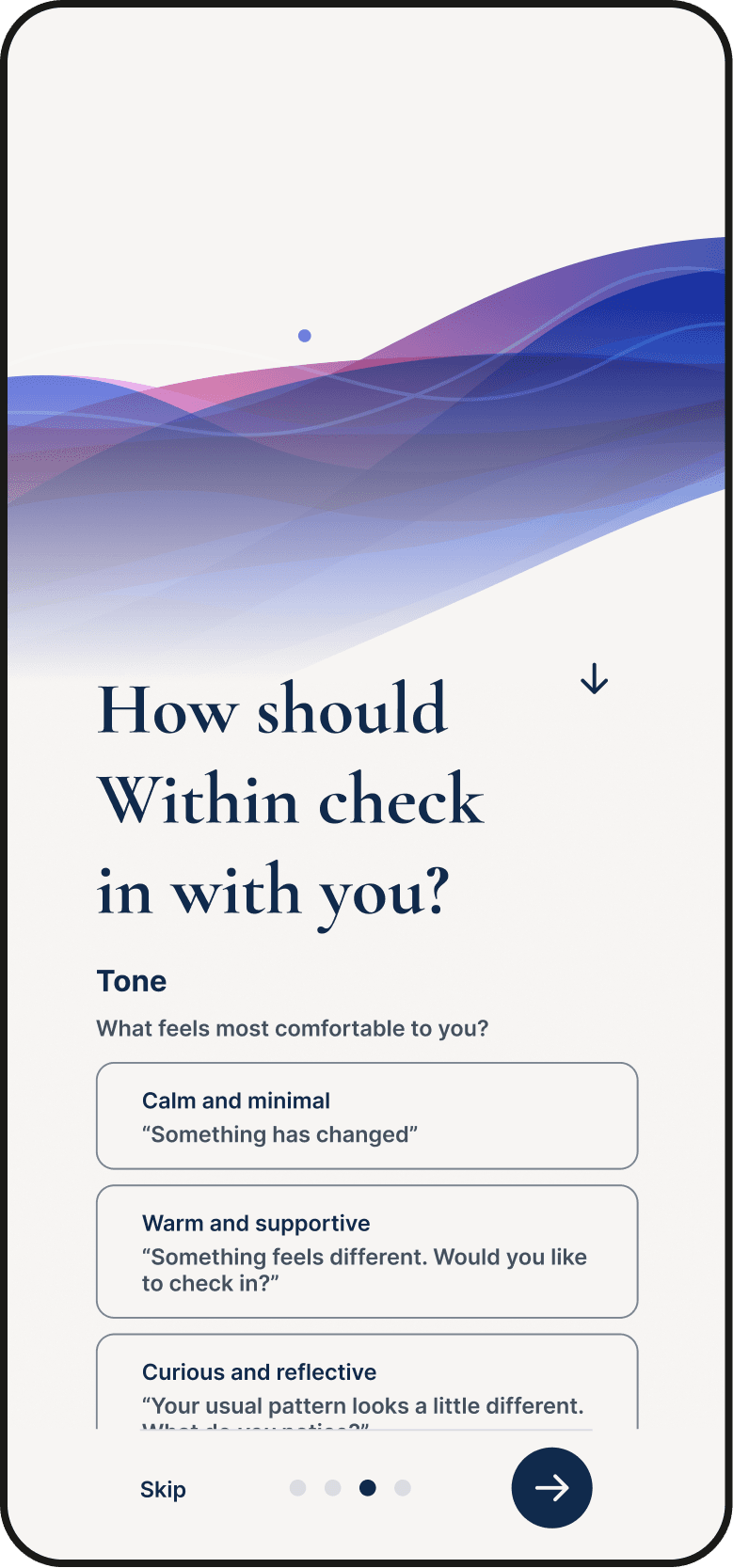
This became the Core User Flow, but I also felt strongly that the onboarding could provide the user the opportunity to dial in their preferences to suit their own communicative needs.

The experience
Two devices. Two moments.
Watch - Immediate awareness
The wearable provides a lightweight entry point into the experience.
A notification communicates a factual change and offers the user a choice:
The watch doesn't attempt to explain the user's emotional state.
Mobile - Deeper reflection.
The phone provides the space for the user to add context, explore choices and look back at patterns.
Core user flow:
——>


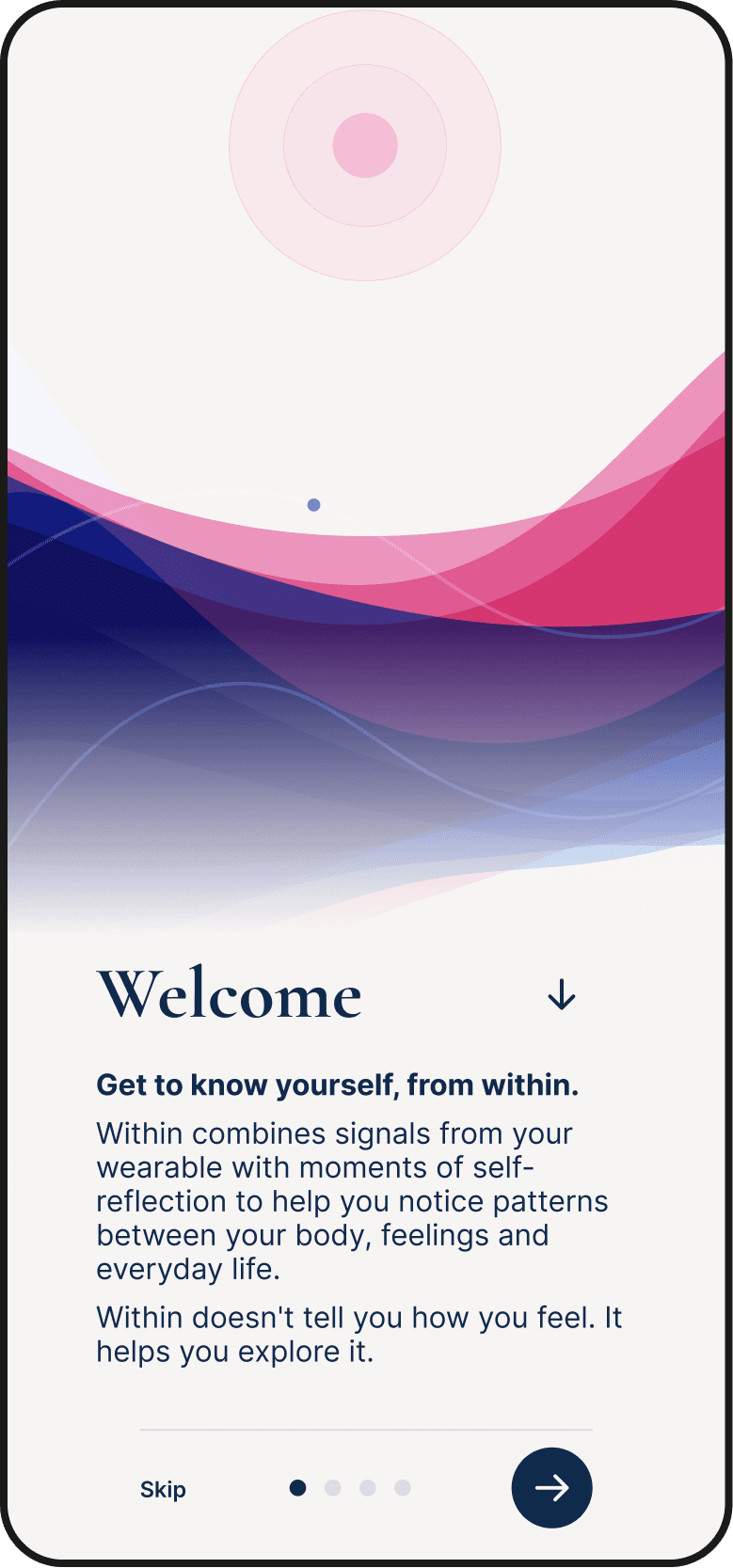
Onboarding flow:
——>



Visual design
A visual language for something internal.
Visually, I wanted the identity to reflect the idea of something happening beneath the surface.
I developed an abstract language based around organic, layered and fluid forms.

The abstract forms are inspired by biological systems. They represent the physical and chemical processes happening beneath our everyday experience.
The idea was that the visualisation could become more complex as more information and context is introduced.
That gave the product a visual connection between data and something much more human and personal.
Developing the design system
I developed a design system to create consistency across the experience while giving the interface enough flexibility to feel personal and expressive. It brought together colour, typography, spacing, components and visual elements into a cohesive system that could work across both mobile and wearable touchpoints.
——>


The outcome
This project started with a simple question
Could wearable data help people recognise changes in themselves earlier?
Through research, the concept evolved into something more nuanced.
Rather than creating another product that interprets health data for the user, Within creates a space where data and personal experience can meet.
The final concept gives the user:
Information without diagnosis.
Support without pressure.
Reflection without judgement.
Insights without pretending to have all the answers.
What I learned
The research repeatedly brought me back to autonomy: users should decide whether to engage, how much information they want, how Within communicates with them and what action they take next.
This changed the role of the product.
Within isn't there to fix the user.
It's there to help them notice what might otherwise go unnoticed, and give them the space to decide what it means.

What I would like to have done.
I’d have liked to take the research and testing further, particularly by testing the core experience with more people and exploring how the concept could evolve through real-world use. I’d also like to develop the wearable and mobile experiences further, exploring how they could work together as a more complete ecosystem rather than as a concept.